
Peck Mountain Anvil and Studios
Unique Handmade Creations and Curated Antiquities

Peck Mountain Archive
Beyond the forge and the sawmill lies a passion for the pieces that have stood the test of time. The Archive is a dedicated space for my finest historical finds—rare antiquities and artifacts that inspire my own craftsmanship and celebrate a legacy of quality that spans generations. These items are more than just inventory; they are a legacy. This archive is my personal tribute to the craftsmanship that came before us and I am proud to be their temporary guardian.


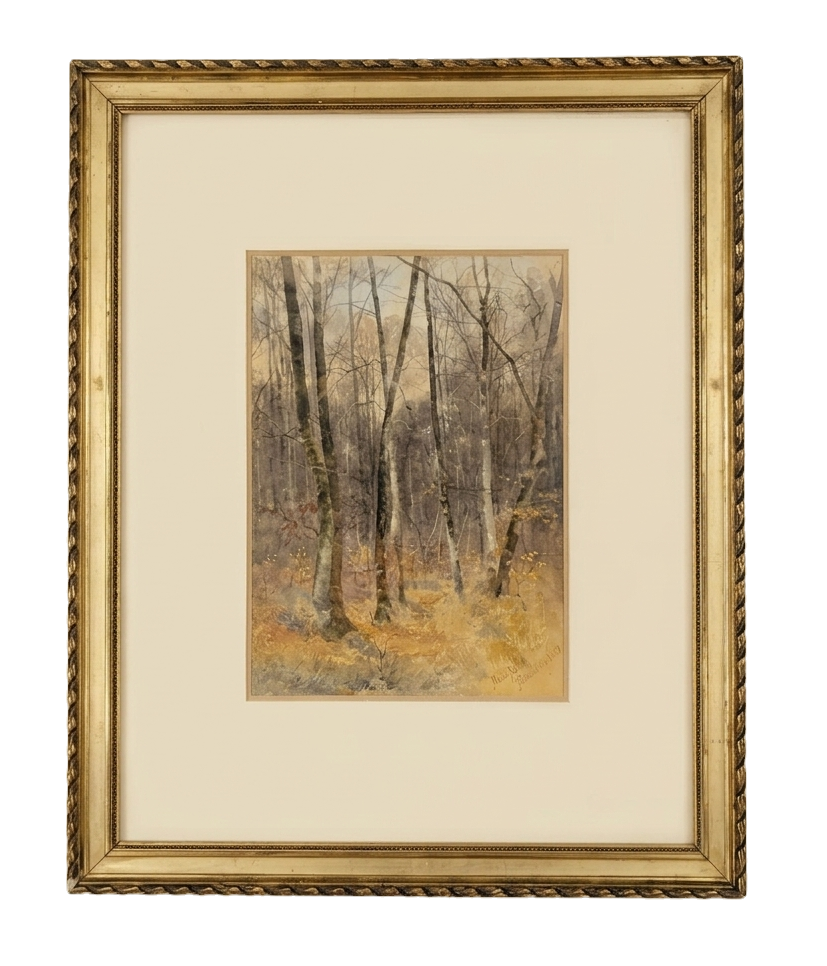
The Legacy of Maud Naftel: A Victorian Master in the Forest of Fontainebleau
The Artist: A Tragic and Trailblazing Talent
Maud Naftel (1856–1890) was not merely a painter; she was a pioneer. Born into a celebrated dynasty of watercolorists, she was trained at the prestigious Slade School of Art in London and later in the Paris studio of Carolus-Duran—the same master who taught John Singer Sargent.
At a time when the art world was a "gentleman’s club," Maud forced her way in through sheer technical brilliance. In 1887, she became one of the first women ever elected to the Royal Society of Painters in Water Colours (RWS). Her influence was so profound that her 1886 book, Flowers and How to Paint Them, became the gold standard for botanical and landscape instruction in England for decades.
Tragically, Maud died at just 33 years old. Because her career lasted only 15 years, her original works are incredibly rare. Most are held in permanent museum collections, such as the Victoria and Albert Museum (V&A) in London, making any privately owned, signed piece a genuine historical treasure.
The Painting: "Fontainebleau" (1883)
This specific work, dated 1883, represents a critical moment in Maud's development. It is the perfect marriage of her English heritage and her French training.
The Subject: The Forest of Fontainebleau was the "Holy Land" for 19th-century artists. It was the birthplace of the Barbizon School, which rejected the "perfect" studio paintings of the past in favor of painting nature exactly as it appeared.
The Composition: Notice how Naftel avoids a wide, sweeping panorama. Instead, she pulls the viewer into the thicket. She focuses on the "vertical rhythm" of the birch and beech trees, capturing the specific, filtered light that only exists under the Fontainebleau canopy.
The Technique: Look closely at the "dappled" floor of the forest. Naftel used a sophisticated "wet-on-dry" technique to layer gold and earthy tones, mimicking the way sunlight hits fallen leaves. The trees aren't just brown sticks; they are alive with texture, moss, and shadow.
Why This Piece is a Historical Treasure
The Provenance: On the reverse, the original labels from Osenat (Paris-Fontainebleau) act as a birth certificate. Osenat is the world’s leading authority on "The School of Fontainebleau." For this painting to have passed through their hands confirms its authenticity and its place within the French art canon.
The Rare Signature: To find a work signed, dated, and titled by Naftel's own hand is a rarity for collectors. It marks this as a "primary work"—one intended for exhibition rather than a mere sketchbook study.
A Window into 1883: This was the year Maud was at her peak, exhibiting at the Grosvenor Gallery in London. This painting is a physical survivor of the high-Victorian era, capturing a forest that has since changed, through eyes that saw the world with a modern, atmospheric clarity long before Impressionism became the global norm.
"To look at this watercolor is to see the Forest of Fontainebleau not as a map, but as a mood. It is a testament to a woman who achieved in 33 years what most artists fail to do in 80: she captured the soul of the woods."


The Guardians of the Yellow River: Majiayao Neolithic Pottery (c. 3300–2000 BCE)
The Artist: The Nameless Masters of the Loess Plateau
These vessels were created by the Majiayao culture, a high-altitude society in the Gansu and Qinghai provinces of China. These potters were pioneers, using the "coil-and-paddle" technique to build perfectly symmetrical forms by hand. To these craftsmen, painting was a spiritual act—a way to bridge the gap between the living world of the river and the eternal world of the ancestors.
The Object: The Majiayao Painted Bowl
The Visual Breakdown:
The Form: At 5 inches wide, this bowl is an intimate, handheld object. Unlike larger storage jars, this form—with its flared rim and rounded basin—suggests a personal use, perhaps for ritual offerings or as a precious household item. It features a clean, handle-less silhouette that emphasizes the fluid geometry of the era.
The Pigment: The dark, bold patterns are painted with an iron-and-manganese-rich earth pigment. Fired in primitive kilns dug into the hillsides, this mineral-based paint has survived 5,000 years without fading—a testament to ancient chemical mastery.
The Geometry: The rhythmic, swirling motifs represent the Yellow River, the lifeblood of their civilization. The sweeping arcs and lines capture the movement of water, symbolizing the flow of life and the cycles of nature.
Why This is a Historical Treasure
A 5,000-Year Survivor These bowls were often "mortuary wares," placed in burial sites to serve the deceased in the afterlife. To hold this piece today is to touch an object that has remained protected by the earth since before the height of the Egyptian pyramids.
The Birth of Chinese Art The Majiayao culture represents the pinnacle of Neolithic painted pottery. The fluid, calligraphic lines seen on this bowl are the direct ancestors of the Chinese brushwork and ink painting that would define Asian art for the next several millennia.
The Fingerprint of Time The piece shows characteristic "calcium bloom" and earthen encrustation (the white, dusty patches). This mineral "skin" is a result of centuries of contact with the soil, acting as a natural fingerprint of its ancient journey.
"When you look at this Majiayao bowl, you are looking at the very first heartbeat of a civilization. Every swirl of black paint was a prayer for the river and a gift for the journey beyond."


The Mark of the Nine Valleys: An 1840s Masterpiece
The Authentication: "Kutani Sei"
The reverse of this charger features a hand-painted iron-red calligraphy mark, a definitive "fingerprint" of the legendary Nine Valleys kilns. The inscription translates to "Kutani Sei" (Made in Kutani). The fluidity and pigment density of this signature are consistent with the high-caliber workshop practices of the Late Edo Period (c. 1840s), long before the mass-export era of the late 19th century.
Historical Significance: The Samurai Twilight
Created during the mid-19th century, this piece is a survivor of a "closed" Japan. While the Shogunate still ruled, these chargers were produced as items of immense prestige for the domestic elite.
Pre-Meiji Rarity: Unlike common "export" Kutani found in the West, this 1840s-era porcelain represents the original Japanese aesthetic, crafted for a culture that had not yet been influenced by Western tastes.
The "Kinran-de" Luxury: The shimmering gold leaf (Kinran-de) and iron-red palette were used to create a "Golden Brocade" effect, mimicking the most expensive silk kimonos of the era.
The Visual Narrative
Central Medallion: A masterfully rendered Phoenix (Ho-o), an auspicious symbol of virtue and grace. The artist used delicate gold highlighting to catch the light on the plumage, setting it against a backdrop of blooming peonies—the "Queen of Flowers"—representing nobility and honor.
The Border: Intricate geometric panels filled with Komon patterns, each a traditional wish for longevity and prosperity, framed by deep iron-red reserves and scrollwork.
Condition: A remarkable historical survivor, retaining its original gilding and deep pigment through nearly two centuries of history.
"To hold this charger is to touch the final years of the Samurai era. It is a brilliant, golden record of a nation's soul—painted with a precision that speaks of a world where time was measured in brushstrokes rather than seconds. It stands as a vibrant bridge between the ancient traditions of the Nine Valleys and the modern world that eventually discovered them."


The Art of the Andes: A 1930s Peruvian Alpaca Fur Textile
This striking piece is a historical treasure representing the intersection of ancient Andean tradition and the sophisticated craftsmanship of the early 20th century.
Description
The artwork is a mixed-media textile created using authentic Alpaca and Llama fur. It features a "pelt-on-pelt" technique, where natural, undyed fibers of varying shades—creams, chocolates, and tans—are meticulously arranged to form the silhouette of two camelids.
-
Texture: The piece utilizes the long, silken guard hairs of the animal to create a three-dimensional, soft-focus effect.
-
Framing: It is housed in a deep shadowbox frame with a stepped, geometric molding. This presentation is crucial for preserving the organic fibers and provides a sense of depth that honors the piece as a significant artifact.
The Story & Historical Context
To understand this piece, one must look at the high altitudes of the Andes Mountains, where the relationship between humans and alpacas dates back over 5,000 years.
The "Fiber of the Gods"
In Incan history, alpaca fiber was known as the "Fiber of the Gods" because it is warmer, softer, and more durable than wool. This piece continues that legacy, showcasing the animal as a central figure of cultural identity.
The 1930s "Indigenismo" Movement
Created in the 1930s, this piece originates from a pivotal era in Peruvian history. This was the height of the Indigenismo movement, where artists sought to reclaim and celebrate indigenous roots. Unlike later mass-produced versions, a 1930s textile was likely handcrafted in a small workshop or by a family of master weavers, reflecting a level of care and skill that predates modern tourism.
Symbolic Significance
The two figures represent community and endurance. In Andean culture, the llama symbolizes protection and hard work, while the alpaca represents prosperity. By using natural colors—exactly as they appeared on the animal nearly a century ago—the artist highlights the purity of the landscape.
Why It Is a Historical Treasure
-
A Century of Preservation: Organic materials like fur are highly delicate. The fact that this piece has survived since the 1930s in such remarkable condition makes it a rare survivor of the early "Golden Age" of Peruvian export art.
-
Pre-Industrial Craft: This is a pre-World War II artifact, made entirely by hand before synthetic dyes or industrial methods became common in the region.
-
A Window into the Past: To look at this textile is to see the exact colors and textures of the Peruvian highlands from 90 years ago. It is a literal "frozen moment" of history, preserved behind glass.
When someone looks at this, they are not just seeing decor; they are seeing a celebration of survival and a 90-year-old link to one of the world's oldest pastoralist traditions.


The Scholar’s Spirit: A Monumental Bitong
Origin: China, Late Qing Dynasty (19th Century)
Material: Rare High-Density "Ghost-Face" Hardwood
The Object
This monumental brush pot, or Bitong, represents the pinnacle of the Chinese "Scholar’s Studio" aesthetic. Standing at a rare 15-inch scale, this vessel was designed to hold the large-format brushes used by masters of calligraphy and landscape painting.
The Material Heritage
Carved from a single, massive section of dense, oil-rich hardwood, the vessel possesses a stone-like heft and a deep, silk lustre patina that only develops over generations of use.
-
The Burl Figure: Features extraordinary "Ghost Face" (Gui Lian) grain patterns, highly sought after by collectors for their mesmerizing symmetry.
-
Authentic Character: Diagnostic testing reveals the presence of natural crimson resins within the wood's cellular structure—a hallmark of the most prized, slow-growth tropical hardwoods historically reserved for the Chinese elite.
The Legacy
To the Qing-era literati, such a piece was more than a tool; it was a symbol of resilience and refined taste. It stands as a silent sentinel of a vanished academic tradition — a mountain in miniature, carved by time.


A JOURNEY OF HISTORY: BUDAPEST TO SHANGHAI
The Personal Library of Paul Komor (1911)
This two-volume set, Ocskay László, II. Rákóczi Ferencz fejedelem brigadérosa, was published in Budapest in 1905, chronicling the life and military campaigns of a legendary brigadier of the Hungarian War of Independence.
A Rare Provenance
What distinguishes these volumes is the inclusion of the original Ex Libris (bookplate) of Paul Komor, dated 1911.
In the world of rare books, an Ex Libris is more than a label; it is a mark of ownership that signifies the book was part of a specific individual's personal library. Paul Komor (1886–1973) was a prominent Hungarian art dealer, diplomat, and humanitarian. Having moved to the Far East as a young man, Komor established himself as a fixture of the international community in pre-revolutionary Shanghai.
A Humanitarian Legacy in Wartime
These volumes traveled with Komor from his Hungarian roots to the international melting pot of Shanghai. His life would later take on profound historical significance during the Second World War.
In 1938, as thousands of Jewish refugees fled Nazi persecution in Europe for the "open port" of Shanghai, Komor co-founded the International Committee for European Immigrants (I.C.)—often called the "Komor Committee." Serving as the Honorary Consul for Hungary, Komor used his position to provide housing, employment, and life-saving international documentation to over 20,000 refugees. He led this committee under the constant watch of Japanese naval intelligence until his arrest in 1942.
A Witness to History
These books were not mere shelf-fillers; they were a piece of home carried by a man who would later dedicate his life to rescuing others during one of history’s darkest chapters.
This set serves as a rare, documented artifact for the collector of 20th-century history, the Holocaust-era refugee experience, and the remarkable legacy of the "old China hands" of Shanghai.


Mission San Juan Capistrano | Oil on Canvas
Artist: Charles Wesley Nicholson (1886–1965)
Medium: Oil on Canvas
Style: California Impressionism
About the Artwork
This piece beautifully captures the architectural elegance and tranquil atmosphere of the historic Mission San Juan Capistrano in California. Known as the "Jewel of the Missions," this site was a frequent and favored subject for Charles Wesley Nicholson. His mastery of light—specifically the way sunlight plays against the iconic arches and casts long, soft shadows across the courtyard—is a signature element of his work. The composition invites the viewer into a moment of quiet reflection, showcasing the blooming vines and the serene, garden-like environment that defined the "Mission Revival" artistic movement in the American West.
About the Artist: Charles Wesley Nicholson (1886–1965)
Charles Wesley Nicholson was a renowned American artist whose work provides a compelling window into the artistic landscape of the early-to-mid 20th century. Born near French Lick, Indiana, Nicholson began his career as a teacher before moving to Chicago in 1908 to work at Marshall Field's and study at the Art Institute of Chicago.
Nicholson’s life was defined by versatility and travel. He designed sets for vaudeville shows and later worked for major motion picture studios in Los Angeles. During the Great Depression, he adapted his style to embrace a more impressionistic approach. He was known for painting "en plein air," traveling the California coast, the Monterey Peninsula, and the Palm Springs area in his Model A Ford to capture the unique, radiant light of the region.
He is highly regarded for his landscapes, seascapes, and his sought-after, rare series of California mission paintings. His work is cherished today for its radiant light, subtle tonal harmony, and poetic connection to the American West.


The Soul of the Facade: The Shvaiko "Matched Set" (c. 1990s)
The Artist: Viktor Shvaiko, A Journey of Resilience
These works were created by Viktor Shvaiko, a Russian-born artist whose life is a testament to the survivalist spirit. Born in the remote Altai region, Shvaiko fled the USSR in 1991 during the Yugoslavian civil war, carrying his canvases on his back for miles across the Italian border. To these works, he brings a deep reverence for European history—using "Romantic Impressionism" to capture the soul of the buildings that sheltered him when he had nothing more than $5 in his pocket.
The Object: A Matched Limited Edition Set
The Visual Breakdown:
The Rare Connection: These two separate works—Mas Des Capelans and Venezia—form a rare "matched set." Both bear the hand-penciled edition number 216/300, confirming they were originally acquired together to be displayed as a diptych.
The Medium: These are hand-signed and numbered limited edition offset lithographs. The heavy archival paper shows the characteristic "skip" of the graphite pencil in the margins, a tactile hallmark of authentic hand-signing.
The Protection: Both pieces are encased in museum-grade Tru Vue Conservation Glass. This specialized glass blocks 99% of ultraviolet light, ensuring the ink and paper remain protected from the fading and "acid burn" that often plagues unprotected works.
Why This is a Contemporary Treasure
The Window to the Past: Shvaiko’s technique mimics the crumbling plaster and weathered stone of Mediterranean architecture. The warm ochres and deep siennas are not just colors; they are an invitation to step into a timeless, sun-drenched sanctuary.
The Artisan’s Preservation: To own this set is to own a piece of art that has been shielded by technology (Conservation Glass) and curated with an eye for symmetry. It is a rare moment where the prestige of the artist meets the highest standards of modern preservation.
"To view these matching works is to step through a curated window into the quiet, sun-drenched corners of Europe. Every weathered stone and glowing window was captured by a man who once carried these very visions across war-torn borders—making these pieces not just art, but a preserved heartbeat of a traveler’s resilience."


A Study in Scale: The 1920s Transitional Club Chair
This exceptional deep-seating club chair, dating from the post-WWI era (c. 1920–1930), stands as a definitive example of early 20th-century American furniture engineering. Combining structural mass with refined, flowing geometry, the piece represents the crucial design transition where late Arts & Crafts/Mission block construction gave way to the bolder, fluid lines of the early Art Deco movement.
Structural Architecture & Anatomy
What distinguishes this armchair is the dramatic silhouette of its solid wood frame. The chair features prominent, wide-plank side panels anchored by heavy square-line front pillars. The defining characteristic is the sweeping, architectural "swoop" of the massive solid wood arms, a precursor to the Streamline Moderne aesthetic that emerged fully in the 1930s. The reverse displays a distinctively tall, barrel-back rake, meticulously bordered with industrial antiqued brass nailhead trim.
True to its period of construction, the internal engineering relies on foundational master-craftsmanship: hand-tied steel coil springs, sawmill oak substructure, a heavy webbing foundation, straight-slot hardware, and robust interior corner-blocking designed to endure for generations.
An Era of Transition
Built during an era when the home library or personal office served as the anchor of the American estate, chairs of this scale were designed to convey permanence and prestige. The deep-set seat and expansive arm width provided a commanding presence in a room.
While many pieces from this specific decade suffered from severe wood degradation or hasty modern paint alterations over the subsequent century, this specimen survived with its original timber integrity and structural components fully intact.
A Witness to History
This chair serves as a rare, documented example of early 20th-century transitional seating, showcasing the structural superiority of pre-depression American craftsmanship and the striking beauty of industrial-artisan restoration.


The Artisan’s Hand: A Federal / Sheraton Era Spool Table
Origin: United States (Southern Region)
Period: Early to Mid-19th Century (Circa 1820s)
Material: Premium Old-Growth Black Walnut & Highly Figured Crotch Walnut
The Object
This exceptional side table, or artisan's worktable, represents the peak of pre-industrial, bench-made American furniture craftsmanship. Standing at a functional 29-inch scale, this versatile vessel was designed to bring both structural utility and high-tier visual elegance to a mid-19th-century estate.
The Material Heritage
Constructed from massive sections of dense, old-growth black walnut, the table possesses a commanding physical heft and a rich honey-patina lustre that only develops over generations of preservation and careful oil-and-beeswax revival.
-
The Crotch Walnut Figure: The dual drawer fronts feature extraordinary, book-matched crotch walnut (or flame walnut) grain patterns. Sourced from the high-pressure fork of a mature walnut tree trunk, these dense, shimmering fibers create deep, three-dimensional "fire-shadow" plumes that serve as the visual centerpiece of the table.
-
The Single-Slab Top: The upper surface is composed of a rare, unbroken 17-inch wide single slab of solid black walnut, showcasing a massive, uninterrupted cathedral grain pattern completely free of veneers.
Structural Marks of Authenticity
True to the realities of early to mid-19th-century cabinetmaking, the table bears diagnostic features that verify its bench-made, non-industrial history:
-
Hand-Whittled Joinery: The solid top is structurally anchored to the apron frame via authentic, exposed wooden pins driven straight through the end grain by the artisan.
-
Hand-Cut Dovetails: The drawers feature widely spaced, hand-sawn dovetails with original craftsman scribe lines visible, paired with period-correct solid poplar secondary wood interiors.
-
Original Hardware & Charm: The drawers retain their original solid wood pulls and an integrated, authentic brass drawer lock mechanism. Reflecting the human element of its creation, the hand-set drawer pulls exhibit a slight, original alignment variation—a classic "smoking gun" of authentic hand-craftsmanship.
-
Victorian Turnings: The piece is supported by four striking, beautifully preserved solid walnut turned-spool (bobbin-style) legs.
To sit beside such a piece is to touch the final years of traditional, pre-factory American woodworking. It stands as a silent sentinel of a vanished artisan tradition—a masterclass in regional joinery, preserved to bring historic weight, narrative, and character to the modern connoisseur's workspace


JAPANESE GIGAKU COMMEMORATIVE REPLICAS: SHISHI & KARURA (1929–1941)
Historical Provenance: The National Treasure Era
These pieces are high-quality, commemorative replicas of Japanese Gigaku theatrical masks, specifically representing the Shishi and Karura figures. Their creation falls within the historically significant window of 1929–1941, initiated by the 1929 National Treasures Preservation Act, which permitted the production of official commemorative replications of cultural assets. This period of production concluded in 1941 due to the wartime ban on luxury goods and the implementation of strict resource rationing.
Artistic Technique and Authenticity
Crafted using the traditional Kanshitsu (dry lacquer) technique, these masks were designed specifically for elite display rather than theatrical performance. Their authenticity is confirmed by several unique identifiers:
-
Registry Labels: Each piece features a handmade washi paper registry label.
-
Calligraphy: The labels are marked with hand-brushed Kokuhō (National Treasure) calligraphy.
-
Authentication Stamps: Each mask bears overlapping double red workshop stamps.
-
Materials: UV inspection has verified the use of period-correct materials consistent with their 1929–1941 origins.
A Witness to History
These masks serve as a rare, documented artifact of the interwar period in Japan, bridging the gap between ancient theatrical tradition and the heightened nationalist preservation efforts of the early 20th century. As pieces intended for elite display, they remain a pristine example of the Kanshitsu craft during the final years before the total wartime mobilization of resources.


The Dawn of Peace: An Armistice Morning Masterpiece
The Provenance: Tuesday, November 12, 1918
This museum-grade artifact features the complete, original morning edition of The Cincinnati Post, printed less than twenty-four hours after the signing of the armistice that concluded World War I. Unlike common clipped front pages, this specimen is a fully intact, multi-page daily time capsule. It features its original, period-correct paper subscriber delivery tag ("Williams G W") affixed to the masthead, anchoring the piece to a specific Ohio Valley home on the most historic morning of the twentieth century.
Historical Significance: The Birth of Veterans Day
Printed at the literal epicenter of global transition, this edition captures the raw, unpolished first draft of world peace before it was consolidated into history textbooks.
-
Wilson’s Imperial Proclamation: The lower-left column preserves the urgent text dispatched from Washington on November 11. In it, President Woodrow Wilson declares the triumph of a "just democracy" and issues an immediate, unscripted directive giving all federal departments a public holiday—marking the exact legislative seed that would eventually bloom into the modern national celebration of Veterans Day.
-
The Global Ledger: The central register acts as a stark inventory of empires falling, outlining the comprehensive and severe macro-terms of the German surrender, from the immediate evacuation of Alsace-Lorraine to the absolute surrender of the Imperial submarine fleet and rolling stock
The Front-Line Narrative
While official dispatches handle the geopolitics of kings and presidents, the paper’s primary column features a legendary, first-person report from United Press staff correspondent Webb Miller, stationed directly with the American Armies in France at the hour of liberation.
-
The Liberation of Verdun: Miller records the precise, spine-chilling moment the guns fell silent northeast of Verdun at 11:00 a.m. Following a final, terrifying sheet of artillery flame, an unprecedented quiet dropped over the trenches, instantly broken as "the bells in war-shattered Verdun began pealing."
-
The Fox-Trotting Doughboys: Capturing the immediate psychological shift of combat veterans, Miller reports motorcycle couriers tearing down dirt roads shouting, "It's over, Boys!"—a simple phrase that instantly "changed grim men into laughing boys" as battle-weary soldiers under full 60-pound packs began dancing and fox-trotting in the middle of the road.
Archival Condition & Artifact Anatomy
-
The Meta-History Directive: Embedded in the lower layout is a rare, beautifully framed box titled "SAVE THIS POST". In a striking moment of self-awareness, the 1918 editors explicitly implore the reader to tuck the paper away for future generations, drawing a direct generational line to their own fathers who saved newspapers from the Civil War surrender at Appomattox.
-
The Hidden Layer: A slight, historic tear on the right margin exposes a fascinating material truth: the intact interior pages underneath. Visible fragments reveal a 1918 department store advertisement detailing "fur-trimmed footwear" and shifting consumer retail prices, proving that everyday commerce and regular life resumed the exact second the conflict ceased.
"To stand before this front page is to read the exact words that met a stunned and celebrating nation on the first full morning of peace. It is not merely a record of an armistice; it is a living, multi-layered monument to the thin line where total war ended and modern remembrance began."


Turn-Of-The-Century Industrial Rocker:
Solid Quarter-Sawn White Oak
About the Piece
This museum-grade transitional rocking chair, crafted circa 1895–1910, is a masterclass in turn-of-the-century American woodworking. Built from solid quarter-sawn white oak, the piece showcases deep, mesmerizing "tiger-stripe" medullary rays alongside classic architectural elements like arched banner-back splats and delicate spindle-under-arm detailing.
The Rare Original Oilcloth Seat
What truly sets this chair apart—and gives it its deep character—is the astonishing survival of its original factory-embossed oilcloth seat. Over more than a century, everyday friction, changing seasons, and decades of use meant that almost all of these delicate upholstered surfaces cracked, split, or were stripped away and replaced. To find an original turn-of-the-century oilcloth cushion still completely intact, retaining its crisp texture and authentic patina, is an extraordinary rarity. It is a tangible link to the past, reminding us of the countless quiet evenings, family stories, and generations of life this rocker quietly witnessed in someone's home.
A Witness to History
This rocker was never just a piece of everyday seating; it is a survivor of a bygone era of American craftsmanship. Preserved in its honest, untouched state, it stands as a warm, living piece of history that brings both unmatched character and a profound sense of timeless heritage to a room.


1820s Federal / Sheraton Style Nightstand: A Piece of Alabama History
The Provenance: A Local Legacy
Acquired directly from the historic Bibb family estate in Huntsville, Alabama, this nightstand carries a wonderful local connection to Alabama's early statehood, as brothers William Wyatt and Thomas Bibb served as the state's first and second governors.
The Style: Federal Elegance & Fine Joinery
Dating back to the 1820s, this original two-drawer piece exemplifies classic Federal and Sheraton craftsmanship. Its defining structural elements include:
-
The Case: A rich cherry wood case finished with a warm, aged patina.
-
The Drawer Fronts: Striking, tiger-striped curly maple drawer fronts that provide a stunning visual contrast.
-
The Silhouette: Delicate turned legs that elevate the piece and maintain its light, graceful 19th-century proportions.
-
The Hardware: Original turned wooden knobs anchoring the two dovetailed drawers.
"To view a piece with this level of local provenance is to step directly into Alabama's early heritage—making this not merely functional antique furniture, but a preserved piece of history."


A HEAVY INDUSTRIAL RELIC: THE MICHIGAN MAPLE BLOCK
The Michigan Maple Block Company (Early 20th Century)
This monumental industrial artifact is a custom-ordered, commercial-grade butcher block, standing as a rare and exceptional survivor from the golden era of heavy-duty American woodworking.
An Industrial Monument
What distinguishes this piece is its sheer scale and survival rate. Measuring a massive 35 inches round and 15 inches thick, this block pushes far beyond standard commercial dimensions—where over 95% of surviving round blocks max out at 24 to 28 inches wide and 10 to 12 inches thick.
In the early 20th century, blocks of this magnitude—weighing around 400 pounds—were custom-ordered for heavy commercial spaces like high-volume meatpacking plants, regional slaughterhouses, and wholesale meat-processing operations where multiple cutters worked simultaneously. Because of their immense weight and solid construction of pressed, glued end-grain hard maple bound under historic internal steel tension rods, the vast majority were eventually discarded, split, or sawed in half over the decades.
Un-Cut Integrity and Provenance
Finding an entirely un-cut, intact 15-inch depth standing at a full counter height of 34.5 inches on its original turned legs is extraordinarily rare. It wears every single honest hack, chop, and knife mark from a century of commercial use, transforming a functional workshop tool into a piece of architectural history.
This block serves as a rare, documented artifact for the collector of 20th-century industrial Americana, commercial antiques, and the rugged workhorses of the American past.


THE HEIRLOOM OF THE HEARTH: AN 1820-1835 COUNTRY PINE CHEST
A Country Masterpiece in Old-Growth Pine
Crafted during the early to mid-19th century, this American country primitive pine blanket chest embodies the rugged utility and honest craftsmanship of rural American woodworking. Built with hand-cut through-dovetails at the corners and raised gracefully on turned bun feet, the chest exhibits a rich, amber-honey patina developed over generations of careful use and preservation.
A Rare Structural Provenance
What distinguishes this specific piece is the authentic hardware craftsmanship preserved within its boards. Secured thoroughly with period-correct machine-cut square-head nails, the joinery offers a physical snapshot of an early 19th-century cabinetmaker's bench and traditional workshop methods.
A Witness to Domestic History
This chest was not a piece of mass-produced factory furniture; it was a utilitarian staple of the 19th-century home, built to safeguard textiles, blankets, and family heirlooms against the elements. Its solid old-growth pine construction and robust interior till reflect a time when household furnishings were built to endure across lifetimes.
An Artifact of American Country Craft
This piece stands as a proud testament to an earlier American epoch, preserving the lasting dignity of hands that built for eternity and a heritage that refuses to fade.
